🎧 Prefer to listen? Audio version below — approximately 12 minutes.
The planning application says “low-carbon on-site generation.” The exhaust stack says something different.
On 18 May 2026, The Guardian reported that more than 100 UK data centres are planning to generate their own electricity using on-site gas plant. The framing was political — net zero ambitions colliding with AI superpower rhetoric. That framing is correct, but it misses the engineering. This piece covers the engineering.
The operators aren’t villains. They’re rational actors in a system that was deliberately rewired to favour them.
Under reforms to the National Planning Policy Framework and the Infrastructure Planning regulations, major data centre developments now qualify as Nationally Significant Infrastructure Projects. That means a single Development Consent Order handled at ministerial level -- no local planning committee, no ward councillor objections, planning, highways, and land acquisition bundled into one approval. CNI status puts data centres on par with water and energy infrastructure. The bureaucratic gates were unbolted by design.
What nobody fixed was the power supply. National Grid connection queues stretch to 2038 in some areas. The government overhauled the queue management -- “first ready, first connected” -- without solving the underlying capacity problem. You can now jump the queue faster to a connection that doesn’t exist yet.
So capital walked through the gates the government opened, found no power on the other side, and built its own. A 50MW gas turbine on an industrial estate delivers in twelve months. A grid connection delivers in a decade. The maths isn’t complicated.
This is what that decision actually involves.
Natural gas burns cleaner than diesel. That much is true and worth stating honestly. The sulphur dioxide drops dramatically, the heavy particulate soot that coats everything downwind of a diesel generator essentially disappears, and on a crisp morning what you mostly see from the stack is water vapour -- the hydrogen in the methane doing exactly what hydrogen does.
But for every carbon atom that enters that engine as methane, one leaves as CO₂. That is not an engineering failure. That is chemistry. You cannot greenwash stoichiometry.
The manufacturers will quote you 350 to 420 grams of CO₂ per kilowatt hour. Those figures are technically accurate -- for utility-scale Combined Cycle Gas Turbines running steam recovery loops at 55% thermal efficiency. A 10 to 50 megawatt open-cycle turbine on an industrial estate in Slough runs at 30 to 35% efficiency. A top-tier lean-burn reciprocating engine does better at 42 to 45%. The unvarnished direct combustion baseline for the kit actually being installed is 440 to 590 grams per kilowatt hour. Before you add anything else.
These are not peaker plants. They are not emergency backup systems. The planning applications being submitted today are for permanent baseload generation -- a complete decoupling from the grid. Not a bridge while connections are arranged. A deliberate exit.
Then you add methane slip.
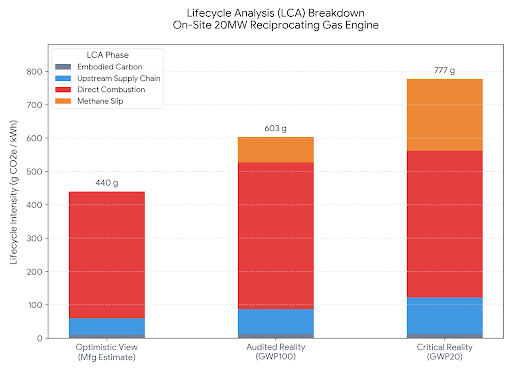
No combustion cycle is perfect. Under variable load -- and data centre load is variable, racks spinning up and down with demand -- unburnt methane escapes through valve transitions. Roughly 1.5% in a reciprocating engine. That releases approximately 2.6 grams of raw methane per kilowatt hour generated. Methane is roughly 80 times more potent than CO₂ over a 20-year horizon -- and 20 years is the relevant horizon, because these assets will still be running in 2044. Under that accounting, methane slip alone adds 215 grams of CO₂ equivalent per kilowatt hour on top of everything else.
Then you add the upstream supply chain. The gas arrives carrying its own footprint -- extraction, compression, thousands of miles of pipeline. Fugitive leaks along that pipeline are a material variable. If the supply chain is well managed, add 50 grams per kilowatt hour. If it isn’t -- and Norwegian import pipelines are not uniformly instrumented to the standard the optimistic models assume -- add 110.
The audited lifetime carbon intensity of a standalone on-site gas plant powering a data centre is 600 to 770 grams of CO₂ equivalent per kilowatt hour. At the pessimistic end of that range, on a 20-year warming horizon, you are approaching the carbon intensity of the diesel generation you were specifically trying to avoid.
The planning application quoted the brochure. The atmosphere receives the audit.
| LCA Phase | Optimistic (Brochure) | Audited Reality (GWP100) | Critical Reality (GWP20) |
|---|---|---|---|
| Embodied Carbon | ~10 g/kWh | ~12 g/kWh | ~12 g/kWh |
| Upstream Supply Chain | ~50 g/kWh | ~75 g/kWh | ~110 g/kWh |
| Direct Combustion | ~380 g/kWh | ~440 g/kWh | ~440 g/kWh |
| Methane Slip | Unquantified | ~76 g/kWh | ~215 g/kWh |
| Total | ~440 g CO₂e/kWh | ~603 g CO₂e/kWh | ~777 g CO₂e/kWh |
Here is the detail that doesn’t appear in the planning application, the press release, or the ESG report.
The National Grid, for all its current inadequacy, gets cleaner every year. Offshore wind comes online. Nuclear capacity returns. The grid average carbon intensity in 2030 will be materially lower than it is today, and lower again in 2035. An operator who waited for a grid connection -- however frustrating that wait -- would be drawing progressively cleaner power across the operational life of their facility.
The operator who built their own gas plant in 2026 locked in 600 to 770 grams of CO₂ equivalent per kilowatt hour until approximately 2044. The grid they bypassed will have transformed around them. Their carbon floor will not have moved.
That asset decision is irreversible in any meaningful timeframe.
Then there is the regulatory accounting. A single large gas power station is a visible political target -- a planning application, an environmental impact assessment, a named installation under emissions monitoring obligations. A hundred medium-sized turbines on industrial estates across England are a hundred separate planning applications, each individually below the thresholds that attract serious regulatory scrutiny, each generating its own exhaust profile, each slipping its own methane into the atmosphere.
The aggregate effect is enormous. The administrative footprint is dispersed to the point of invisibility. There is no single responsible party. There is no consolidated emissions figure. There is no regulator with the whole picture on their desk.
The methane slip alone -- 2.6 grams per kilowatt hour, unmonitored, unreported, atmospherically real -- is occurring simultaneously across a hundred sites. Nobody is adding it up.
And then the offsets arrive.
Carbon credits purchased from forestry projects in jurisdictions with variable land tenure, uncertain additionality, and a documented history of the underlying sequestration not materialising or burning down before the credits are retired. A consultancy takes its facilitation fee. The credits are logged as retired. The CO₂ remains in the atmosphere. The ESG report records the commitment.
The voluntary carbon market has no meaningful integrity enforcement. For a data centre operator running continuous high-load gas generation, the volumes required to offset honestly would be so large that the credit purchases alone would expose the scale of the emissions they are trying to account for. So the credits are symbolic. Everyone in the room knows they are symbolic. The room has very good air conditioning, powered by gas.
Ed Miliband has a net zero problem. Not an abstract, future-tense, subject-to-review net zero problem. A present tense, planning-application-already-submitted, exhaust-already-venting net zero problem.
The Energy Secretary has staked his political credibility on a clean energy superpower narrative. His colleague Angela Rayner unlocked the planning gates for data centres as Critical National Infrastructure. Nobody stress-tested what would happen when capital walked through those gates and found the grid wasn’t ready. The answer, it turns out, is a hundred gas turbines on industrial estates, each one a rational decision, collectively a carbon accounting catastrophe.
And the gas isn’t even British.
North Sea production has been in structural decline for two decades. The gas powering Britain’s AI superpower ambitions travels down pipelines from Norway; extraction, compression, liquefaction in some cases, thousands of miles of transit, fugitive methane leaking at every joint and valve along the route. The energy security argument; the fallback position when the climate argument becomes uncomfortable; doesn’t survive contact with a pipeline map. You have not reduced import dependency. You have simply cut out the grid as the middleman.
So what does the net zero commitment look like from the perimeter fence?
It looks like four kilowatts of solar panels on the gatehouse roof. Genuine, sincere, utterly irrelevant against the 50 megawatt gas turbine humming behind the security barrier.
It looks like 2.3 kilometres of native mixed hedgerow; hawthorn and blackthorn, dense enough to deter intruders, biodiverse enough to satisfy the planning ecologist, carbon-sequestering enough to appear in the ESG report under “Nature Recovery Commitments.” Planted around the perimeter of an asset venting unmonitored methane to atmosphere twenty-four hours a day.
It looks like a portfolio of carbon credits retired against a forestry project in Borneo. The forest may still be standing. The credits have been logged. The CO₂ is in the atmosphere regardless.
Ed Miliband’s net zero target remains on the government website. The exhaust plume doesn’t read government websites.
For every carbon atom that enters that engine as methane, one leaves as CO₂. That was true in the opening paragraph. It remains true at the perimeter fence, behind the hawthorn, under the solar panels, regardless of what the ESG report says.
Chemistry doesn’t do offsets.
Sources: The Guardian, 18 May 2026; Future Energy Networks (Silvia Simon, head of research); Ofgem (Stuart Okin, director of cyber regulation, All-Energy conference, Glasgow).
The Sovereign Auditor covers digital sovereignty, cybersecurity governance, and data protection policy -- with a particular focus on Isle of Man jurisdiction and Crown Dependency issues.
Payments via PayPal. Credentials delivered by email. No Substack. No Stripe. No middlemen.